

Schwalbe Tacky Chan Tire


| Where To Buy | |||
|---|---|---|---|

|
Free shipping on orders over $49 (continental U.S. only).
International shipping available. Some exclusions apply. |
Free shipping on orders over $49 (continental U.S. only).
International shipping available. Some exclusions apply. $102.00
|
|

|
|||

|
|||

|
|||

|
|||

|
|||

|
|||

|
|||

|
|||

|
|||

|
|||

|
|||

|
|||

|
|||

|
|||

|
Free shipping on orders over $50 (continental U.S. only).
International shipping available. Some exclusions apply. |
Free shipping on orders over $50 (continental U.S. only).
International shipping available. Some exclusions apply. $108.00
|
|
|
|||

|
Free U.S. shipping on everything.
International shipping available. Some exclusions apply. |
Free U.S. shipping on everything.
International shipping available. Some exclusions apply. $76.31
|
|

|
|||

|
|||

|
|||

|
|||

|
|||

|
|||

|
|||

|
|||

|
|||

|
Free standard UK delivery on orders over £50.
|
Free standard UK delivery on orders over £50.
£56.99
|
|
|
|||
|
|||
|
|||
|
|||
|
|||
|
|||
|
|||
|
|||

|
Free shipping on orders over $69 (continental U.S. only).
International shipping available. Some exclusions apply. |
Free shipping on orders over $69 (continental U.S. only).
International shipping available. Some exclusions apply. $80.86
|
|
|
|||

When Schwalbe released the Tacky Chan in June 2023, I wasn't super impressed. I racked up just enough rides to write it off for anything but firm, consistent conditions, and that was that. But after seeing plenty of fast riders ripping on TCs in deeper, steeper, sloppier conditions (and reading some mixed reviews in our tire forum), I began to question if I'd done my due diligence. I felt like I owed Mr. Chan a second chance and our audience further insight into when and where this tire rips and slips. So here's an attempt to foe into friend with Schwalbe's Tacky Chan.
Highlights
- 2.4-inch width
- 27.5- and 29-inch sizes
- Casing options: Super Ground, Super Trail, Super Gravity, Super Downhill
- Compound options: ADDIX Soft and Ultra Soft
- 'L' shaped shoulder lugs
- Dual-closed siping on should lugs
- Ramped center knobs
- Weight (29", Super Gravity): Ultra Soft - 1326g // Soft - 1354g
- MSRP: $104 USD (Super Downhill, Super Gravity) // $98 USD (Super Trail, Super Ground)
Strengths | Weaknesses |
|
|
Product Overview
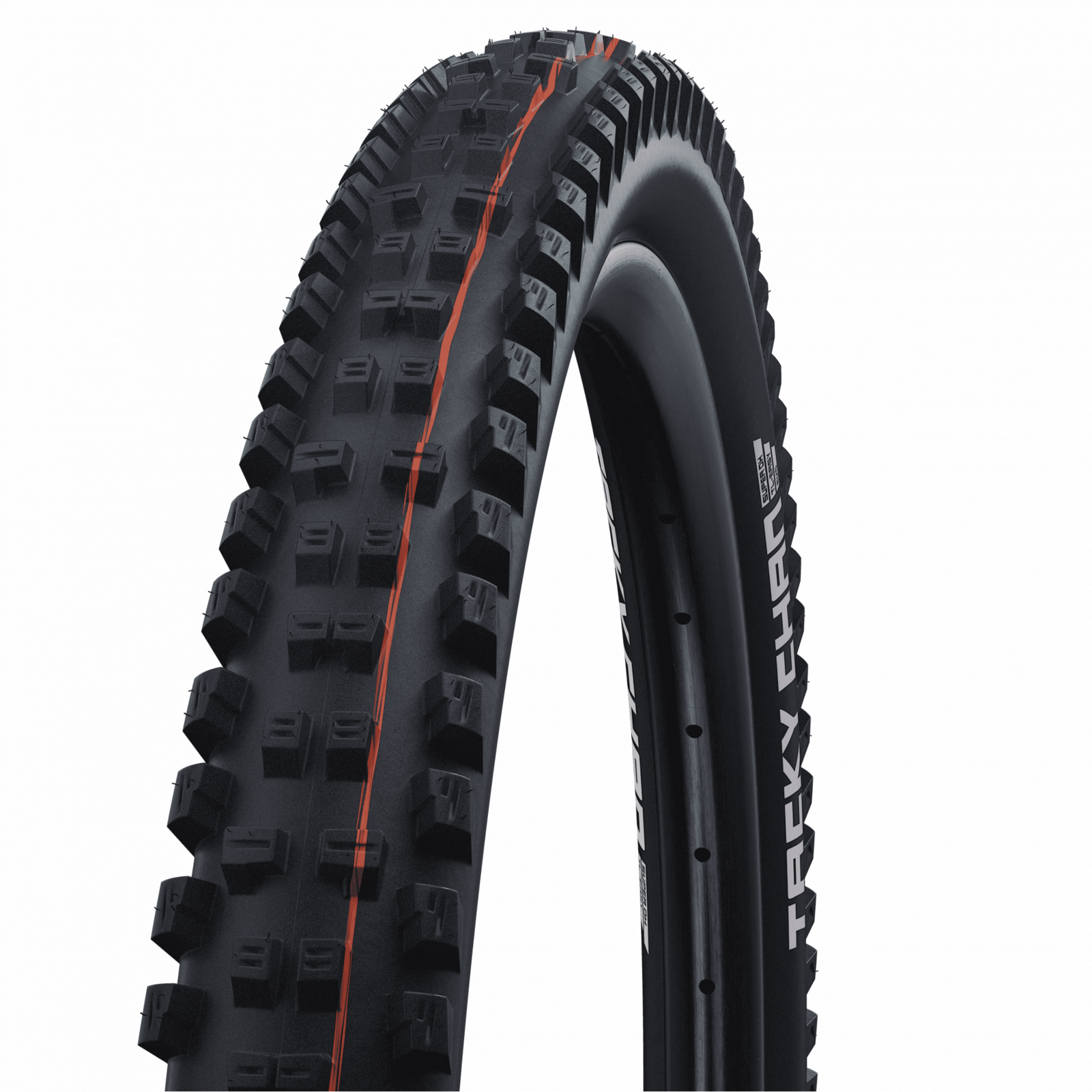
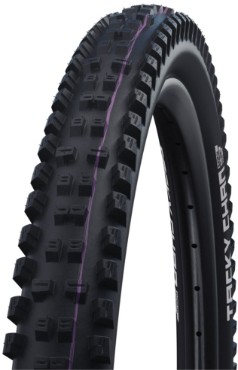
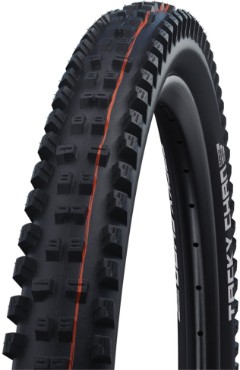
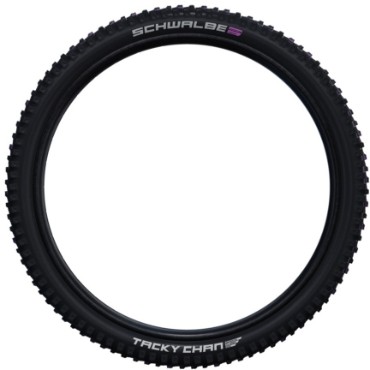
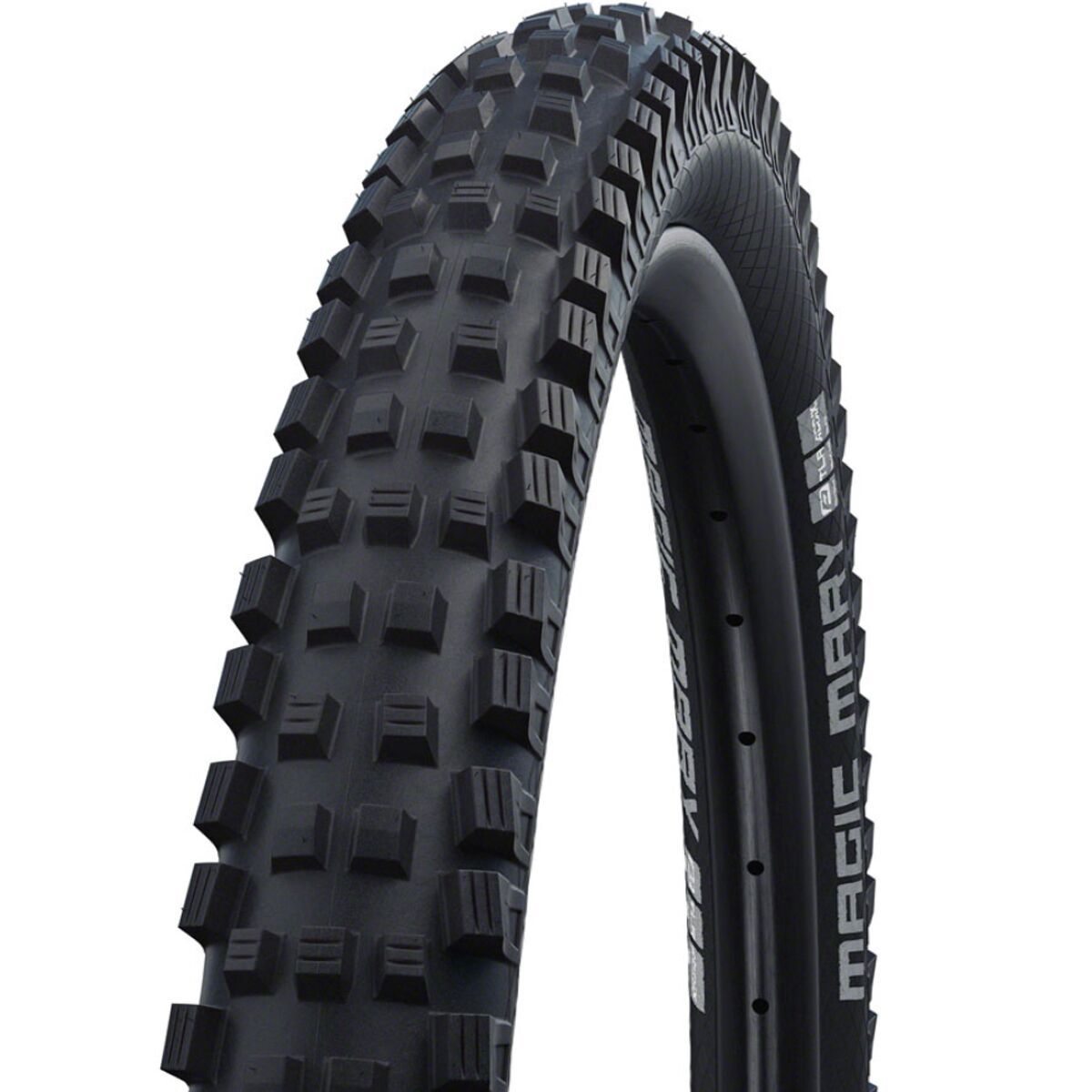
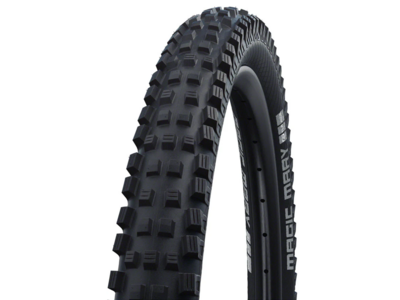
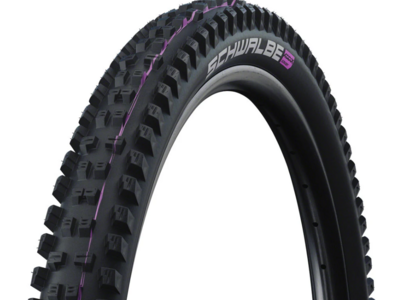
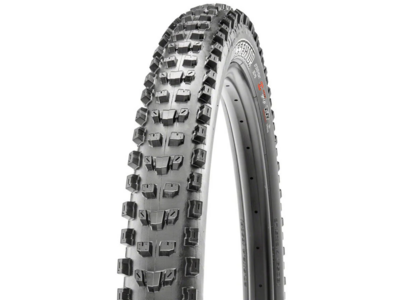
Tacky Chan is dubbed by Schwalbe as the fastest downhill tire in the world. Marketing hype, yes, but it's not complete hyperbole. The Tacky Chan was designed to be a faster rolling version of Schwalbe's Magic Mary. It features rows of ramped knobs down the center of the tread that lay fairly flat, making the tire noticeably faster rolling than most gravity tires. There are three variations of center knob rows:
- Two wide knobs spaced further apart with partial ramping
- Two small, ramped knobs placed close together
- One knob separated by a sipe with a notch in the ramp
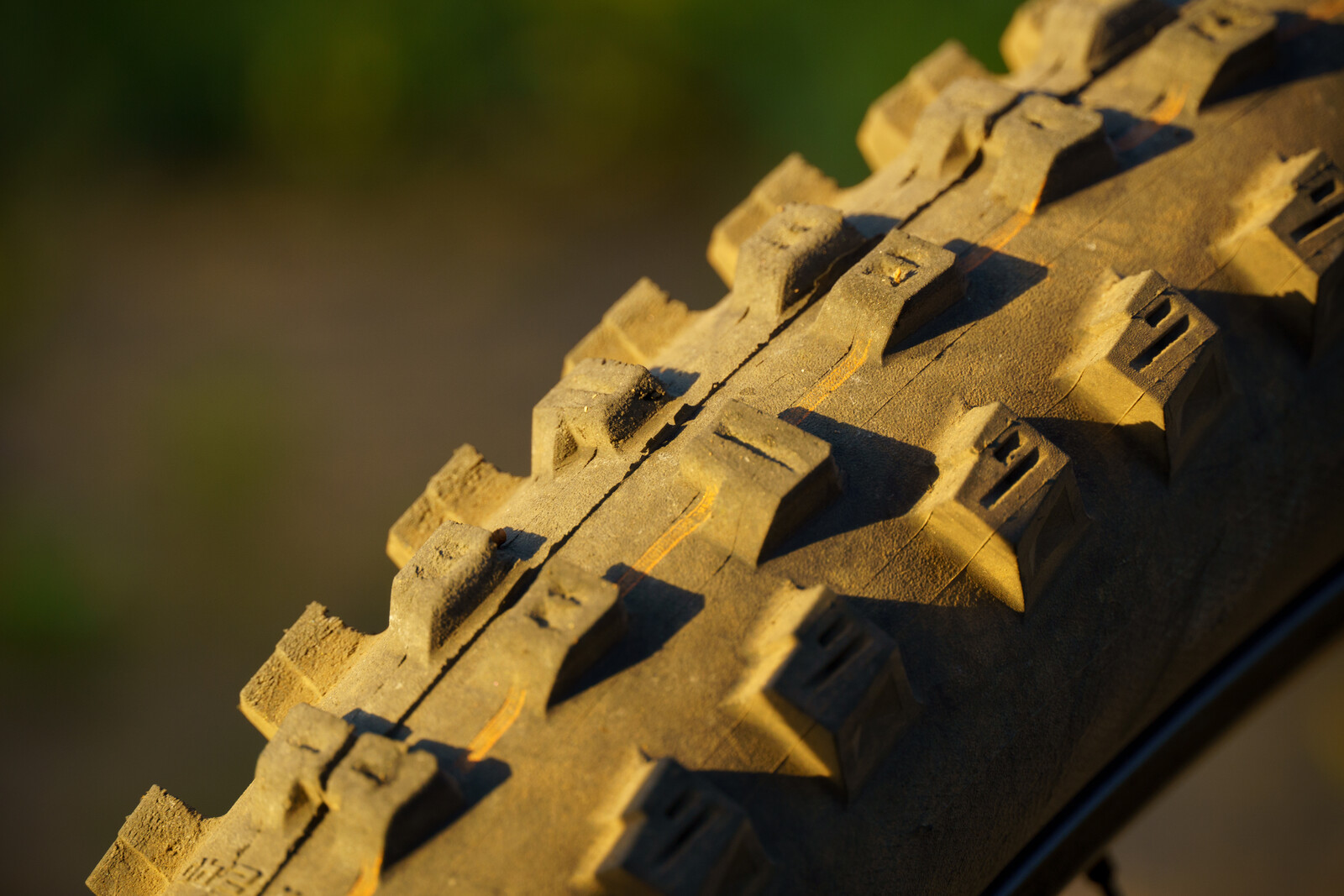


The tread follows a 1-2-3-2-1 pattern. All knobs have closed sipes.
Two things stand out about the center tread. First, row 1 provides the only transition-esque knobs that only repeat every 9.6cm (3.75 inches). This leads to distinct cornering characteristics when used as a front tire, which I'll get into below. And second, the back of the knobs on each row are rather sharp, and cupped slightly. This gives the Tacky Chan more braking bite than meets the eye.

L-shaped side lugs sit slightly flared out and in parallel to each other. The lugs are all the same and have modest closed sipes, allowing for marginal knob flex. Since the Tacky Chan is a result of riders wanting characteristics they couldn't get from the Magic Mary, the shoulder lugs are intentionally more stout. On one hand, I agree that the MM can squirm when you overpower its heavily siped side lugs. On the other hand, those lugs are truly magical when finding grip in tricky conditions.

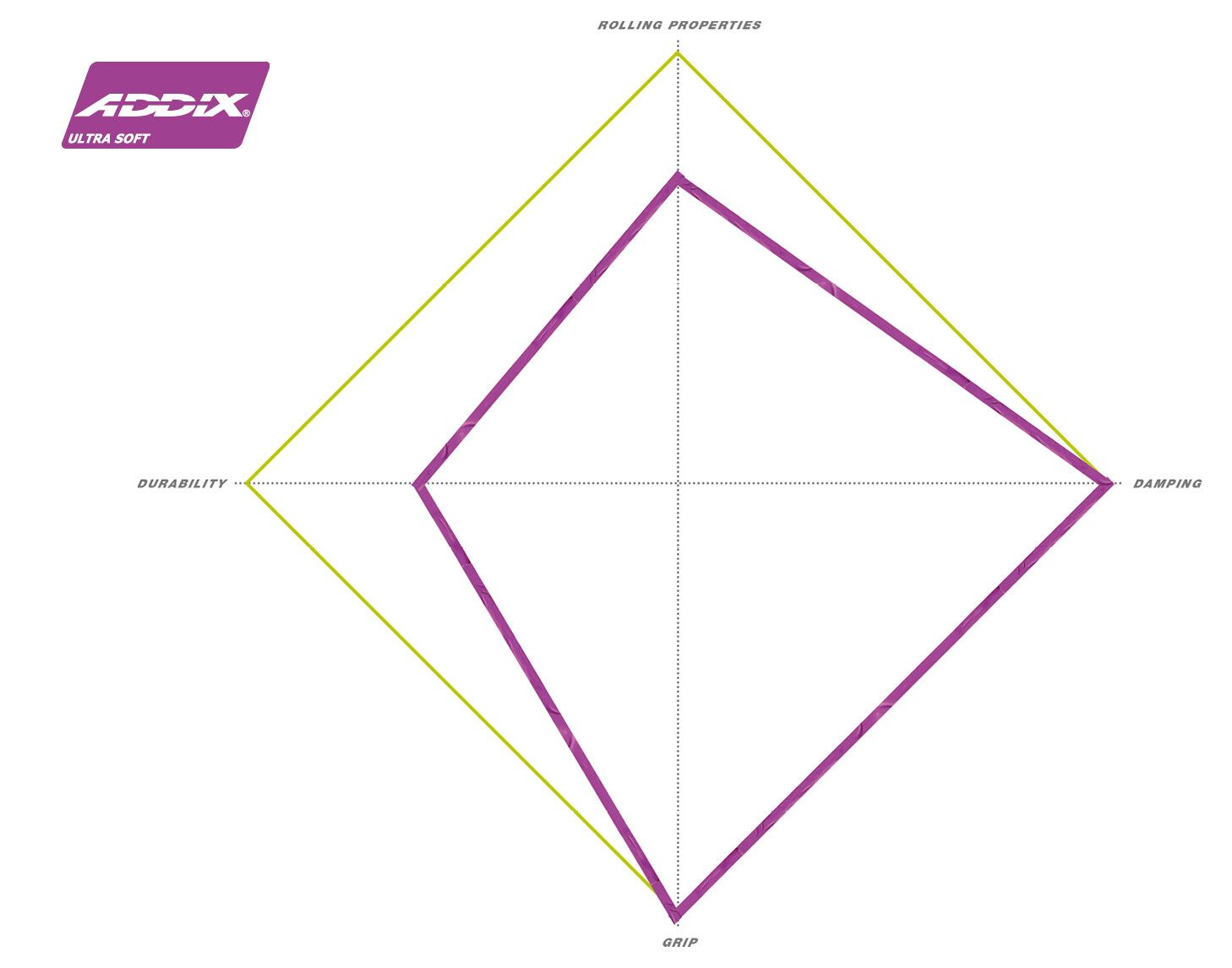
Schwalbe offers the Tacky Chan in four casings and two compound options. It only comes in a 2.4" width for 27.5- or 29-inch wheels. I tested the Super Gravity casing, with an Addix Ultra Soft up front, and an Addix Soft in the rear. Schwalbe's casing and compound nomenclature are mostly straightforward, but if you need more clarity, they provide a nice breakdown of casing construction here and compound intended use here.


If you're riding a 130-160mm travel bike, you'll be best served by the Super Trail or Super Gravity casing. To decide between the two, consider your terrain, how hard you ride, and how much you care about rolling weight. Construction-wise, the main difference between the two is that Super Trail has three carcass plies under the tread, while Super Gravity has four. This leads to a ~180 gram difference when comparing 29-inch tires with the Ultra Soft compound.
Super Gravity does retail for $6 more than Super Trail. However, there is no price difference between the Addix Ultra Soft and Soft compounds. I would recommend using an Ultra Soft in the front and a Soft in the rear. If you are seeking maximum rolling speed, or have grippy terrain with minimal loose rocks or roots, I could see using a Soft in the front. But I hate pushing my front wheel more than smashing my shin into a trailer hitch, so I'll always opt for maximum gumminess up front.
On The Trail
I tested the tires in Reno, Auburn, Santa Cruz, Laguna Beach, and my go-to spots around San Diego. Conditions included sun-backed and hardpack clay, tacky duff with endless traction, firm singletrack with a greasy top layer, sand over hardpack, gravel over hardpack, and lots of square-edge rocks. The only condition I didn't test in was sloppy, thick mud. But I wouldn't pick the Tacky Chan for such conditions anyways due to its shallower center knobs.


I ran my usual tire pressure of 25 psi front and 27 psi rear. I did play around with running 2-3 psi more or less based on conditions—less pressure when it was slicker or less predictable, and more pressure when it was rougher and more hardpack. In either instance, I didn't notice much of a change in performance. For me, tire pressure is a balance of ground feel, traction, lateral support, and rim protection. The lower end of my testing pressures (20 psi front, 25 psi rear) added some damping and security in slippery conditions, but caused some tire roll in turns and deflection through rocks. The higher end of my testing pressures (27 psi front, 30 psi rear) was nice for smooth jump trails or low-angle trails but got dicey in looser soil. All that said—I mostly just stuck with my go-to pressures for simplicity and consistency.
All testing took place on an alloy Stumpjumper 15 with tires mounted to We Are One Triad rims, which have a 30mm internal rim width, 4.5mm bead height, and a 37.7mm outer rim width. The tires measured a true 2.4 inches (61mm) from side lug to side lug. The casing was slightly narrower at 2.28 inches (58mm). Here is how the Tacky Chan compares to some other popular tires when mounted to a 30mm ID rim:
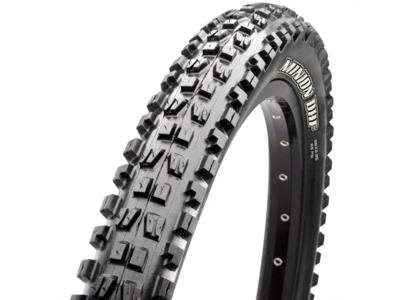
- 2.4" Maxxis DHR II: 57mm (2.24-inches) casing width // 60mm (2.36-inches) tread width
- 2.4" Continental Kryptotal: 60mm (2.36-inches) casing width // 60mm (2.36-inches) tread width
- 2.5" Maxxis Assegai: 59mm (2.32-inches) casing width // 64mm (2.51-inches) tread width
Tread Performance / Overall Grip
The Tacky Chan was a love-hate tire to test. It definitely toyed with my emotions. Sometimes, it was right there to support my shredding. Other times, it didn't even show up, often when I needed it most. To digest this somewhat toxic relationship, I separated the tread into three parts—center knobs, side lugs, and no man's land in between.
The ramped and generously spaced center knobs equated to high coasting speeds and solid traction on fast, straight trails with firmer, consistent soil. Anytime the ground offered traction without requiring the tread to dig in, Tacky Chans were rad. They're also incredible at slowing down. I had the most fun riding the tires in Santa Cruz. There, the trails are fairly steep and direct, and corners are well-supported or bowled-out. The dirt was packed in after some rain the week before, yielding all-time Spring-time hero dirt by my standards. Or, as the SC locs might describe it, "Kinda dry, kinda blown out."

Everywhere else I tested, the conditions were drier and mixed, and the more loose, rocky, or deep the dirt became, the less bite and hold the shallow center knobs could muster. It wasn't all bad, but it was tough to ride blown-out trails as the tire would fluctuate in its ability to hold lines. The real issue was making the jump from center knobs to side lugs without getting lost in no man's land. I'll cover that in the next section, as this was the real culprit behind my love-hate relationship with Tacky Chan. Especially as a front tire.


There was a sweet spot, or rather sweet lean angle, when the side lugs were exceptional. They are placed further down the sidewall (or outboard) than some tires. This gives the tire a rounder profile and a less definitive edge of lean angle traction. It also means you have to lean pretty far to get the lugs to sink into the ground. The lugs are definitely on the stiffer side and offer a ton of grip when engaged. I was pleasantly surprised by how well the tire held traction across off-cambers.

I've racked up just shy of 100 miles and around 20,000 feet of descending on my Tacky Chans, and the rear tire is deteriorating at a slightly slower-than-average rate for a soft compound. There are a few minor creases forming along the inside of the side knobs, but overall tread health is good. The front tire is in great shape. It will get recycled to the rear once the current tire is completely cooked.
Cornering Traction
I struggled to gain cornering confidence from the Tacky Chan as a front tire. Two factors contributed to this—the lack of a transition knob, and the round, somewhat stepped tread profile. With no knob to hold traction through no man's land, you end up with an all-or-nothing mentality to obtain cornering traction. The tire worked great on long, wide turns or berms where you aren't actually leaning that far over. The same was true when diving into tight ruts, as the side lugs have a ton of hold once you're riding on them. My problem was I regularly ended up somewhere in between, turning on what felt like marbles and praying I wouldn't tuck the front. This phenomenon was less prominent when riding firmer trails or dirt with some moisture in it.

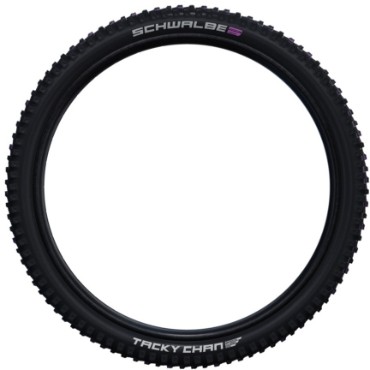
Looking at the profile of the tire, you can see how the center knobs sit fairly flat, while the side lugs are placed pretty far down the sidewall. This creates a decent height difference between the two sections of the tire. The side lugs also sit more perpendicular to the center knobs. On the trail, this profile seemed to compound the lack of a transition knob. The gap and angle at which you have to lean over to get the side lugs to make full contact with the ground was sizable. If it was a tight corner, and I quickly transitioned to the side lugs, the tire was pretty predictable. If I was gradually leaning over, I had to lean quite far to get the side lugs to begin holding traction, by which point it was often a little too late. Overall, as a front tire, cornering traction was too inconsistent and vague for my loose, mixed conditions.
As a rear tire, the Tacky Chan rarely caught me on my toes. The height difference and hand-off from center to side knobs actually helped my rear wheel settle or 'drop' into turns. I never experienced my rear wheel stepping out in turns and always had an idea of how the tire would react when leaning over. I don't think I experienced the same issues that plagued the tires' performance up front because the rear wheel generally follows the front. There is also more weight over the rear wheel, which helps the tire remain planted on the ground. At least that's my theory. Whatever the reason, I was thankful I didn't have to battle both wheels for traction.
Braking Traction
I was honestly shocked by Tacky Chan's ability to drop anchor without breaking traction in varied conditions. Especially after fighting to get the front tire to bite into the ground anytime there was loose rocks or dirt on top of a firm base. I think the difference in performance stems from how the tire engages the ground under braking load versus being unweighted descending.

Tacky Chan's flat profile across the middle of the tire combined with the center knobs' sharp braking edge, gives the tire a lot of surface area to conform to the ground. The inner edge of the side lugs also grab what they can when braking on a slope. I sought out some terribly loose skid trails in the spirit of product testing, and had no problem creeping along without locking up either wheel.
On top of the rolling speed, the braking abilities of the Tacky Chan solidify it as a superb rear tire in my eyes. I've been a High Roller II user for years, but plan to rotate in some TCs moving forward.
Predictability
Due to its subpar cornering abilities, the Tacky Chan was not the most predictable front tire I've tested. As I rode the tire more and understood its corks, I got better at anticipating when traction would fade. As a rear tire, I rarely struggled to predict when it would push or slide—whether that was cornering or under braking.
Casing Performance
The Super Gravity casing offered a good mix of ground feel and damping. A nice, happy medium for aggressive trail and enduro riding. It didn't completely mute chatter, but it wasn't uncomfortable. I never had either tire fold when loading my bike up in corners and I hit enough square-edge rocks to trust the sidewall's ability to protect my rims.
At just over 1300 grams, it's on par with most comparable casings from other brands. I also found the rolling efficiency of the Tacky Chan helped mask its weight.

What's The Bottom Line?
My second go testing the Tacky Chan resulted in a better understanding of the tire's abilities while reinforcing many of my opinions from two years ago. Did I turn foe into friend? Kind of. We are more like cordial acquaintances now. I learned that the Tacky Chan is an excellent rear tire. It offers good climbing traction, impressive braking bite, and is predictable in mixed conditions. However, I still wouldn't pick it as a front tire. The lack of a transition knob and tough-to-reach side lugs makes for inconsistent cornering traction that limits confidence. But pair a Tacky Chan with a Magic Mary up front, and now we're talking.
Score Breakdown
- Tread Performance / Overall Grip: 3.5
- Casing Performance: 4
- Cornering Traction: Front - 3 // Rear - 3.75
- Predictability: Front - 3.25 // Rear - 4
- Braking Traction: 4.25
- Overall: Front - 3.6 // Rear - 3.9
(Scores out of 5)
About The Tester
Jason Schroeder - Age: 30 // Years Riding MTB: 19 // Height: 6' (1.8m) // Weight: 175-pounds (79.3kg)
A once-upon-a-time World Cup downhill racer turned desk jockey, Jason has spent years within the bicycle industry from both sides of the tape. A fan of all-day adventures in the saddle or flowing around a bowl at the skatepark, he doesn't discriminate from any form of two-wheeled riding.

Specifications
- Developed over two years in the World Cup races, including with DH overall World Cup winner Amaury Pierron
- Optimized 100% for precision
- 10% more stable shoulder lugs compared to the Magic Mary for even more aggressive cornering
- Long braking edges allow later braking point
- Open shoulder area provides direct feedback and improves self-cleaning
- Ramps on center lugs for optimal rolling characteristics
- On average 8% lighter than Magic Mary
- Produced with fair trade rubber
| Where To Buy | |||
|---|---|---|---|
|
|
Free shipping on orders over $49 (continental U.S. only).
International shipping available. Some exclusions apply. |
Free shipping on orders over $49 (continental U.S. only).
International shipping available. Some exclusions apply. $102.00
|
|
|
|
|||
|
|
|||
|
|
|||
|
|
|||
|
|
|||
|
|
|||
|
|
|||
|
|
|||
|
|
|||
|
|
|||
|
|
|||
|
|
|||
|
|
|||
|
|
|||
|
|
Free shipping on orders over $50 (continental U.S. only).
International shipping available. Some exclusions apply. |
Free shipping on orders over $50 (continental U.S. only).
International shipping available. Some exclusions apply. $108.00
|
|
|
|
|||
|
|
Free U.S. shipping on everything.
International shipping available. Some exclusions apply. |
Free U.S. shipping on everything.
International shipping available. Some exclusions apply. $76.31
|
|
|
|
|||
|
|
|||
|
|
|||
|
|
|||
|
|
|||
|
|
|||
|
|
|||
|
|
|||
|
|
|||
|
|
Free standard UK delivery on orders over £50.
|
Free standard UK delivery on orders over £50.
£56.99
|
|
|
|
|||
|
|
|||
|
|
|||
|
|
|||
|
|
|||
|
|
|||
|
|
|||
|
|
|||
|
|
Free shipping on orders over $69 (continental U.S. only).
International shipping available. Some exclusions apply. |
Free shipping on orders over $69 (continental U.S. only).
International shipping available. Some exclusions apply. $80.86
|
|
|
|
|||






20 comments
Post a reply to: TESTED: Schwalbe Tacky Chan