



Twelve years. That’s how long it’s been since SRAM debuted its X01 DH 7-speed drivetrain. What’s ludicrous is that someone won a World Cup with X01 in 2013 and 2025. For a sport that prides itself on constant innovation in the name of marginal gains, it's pretty rich realizing Loic Bruni has been racing a priceless Specialized prototype powered by a decade-old gear system. It’s also a clear indicator that SRAM crushed it with the last generation of mechanical shifting.
But all good things eventually come to an end. Or in this case, they evolve.
If you tuned into World Cups last year, you likely saw a few racers sporting what looked like a fully-baked SRAM wireless DH Transmission. It carried all the traits that we’ve become attuned with from 12-speed Eagle Transmission—a hangerless derailleur, a flat top chain, POD shifter, and Swiss cheese-looking cranks. It wasn't an ‘if’ we were getting wireless shifting for DH, but a ‘when’ for all of us common folk. Now, six months later, SRAM’s flashy XX DH Transmission is here.
DH Transmission Overview
Let’s start by clearing the air on two things:
- This is a wireless, electronic drivetrain. If you plan to die with a shifter cable in hand, this probably isn’t for you. Thankfully, X01 and GX mechanical 7-speed will continue to be available. Rejoice.
- XX is SRAM’s highest tier of components with a painfully high price point. XX DH Transmission retails for $2,025. The derailleur is $700. Ouch. However, we can all assume X01 or GX versions will be a reality in the future. If you really can't help yourself, jump into the comments to complain without learning anything about the system.

XX DH Transmission is the culmination of technologies drawn from SRAM’s 12-speed Eagle Transmission and testing with World Cup riders to understand how they could build a better DH drivetrain. Going wireless was only part of the equation. It enabled consistent, firmware-driven shifting and reduced the number of cables in a DH cockpit by a third. The real opportunities for performance gains came from applying SRAM’s X-SYNC tooth design, shift mapping, and direct-to-frame derailleur mount to a DH setting.

SRAM did a bunch of testing with racers to understand how they change gears. Turns out, with their mechanical drivetrain, most riders let off the gas momentarily during a shift (don’t we all?). A dip in power means less speed and lost time. X-SYNC shifting maintains constant chain engagement during gear changes at well-timed shift ramps. This way, you don’t have to let up when smashing gears. Saving fractions of a second may not be a priority for most riders, but for anyone who’s ridden 12-speed Transmission, especially on an eMTB, you’ve experienced how well the system handles high-load shifts. It’s definitely more reliable than the previous mechanical drivetrains.
I recognize that a $700 derailleur dangling from a DH bike is absurd in many ways. But hear me out.
The stiffness of SRAM’s Full Mount derailleur interface is another important factor in delivering consistent shifts. It’s also enabled SRAM to create what I think is the burliest and quietest DH derailleur to date. I know, big claims. I also recognize that a $700 derailleur dangling from a DH bike is absurd in many ways. But hear me out.

The Full Mount design places the derailleur inboard and tucked up under the chainstay more than it would be if mounted on a hanger. I’m not saying you can’t still rip it off, but it’s harder to do than before. In the event of an impact, the derailleur can still rotate backward. From my experience with 12-speed Transmission, the Full Mount interface is incredibly strong due to the way it clamps around the frame and axle. I’ve rarely mangled one of those derailleurs, and they hang down much further.
It’s stupid quiet. Which if I’m being honest, is the main thing I want from my DH drivetrain. Make me forget I even have gears.
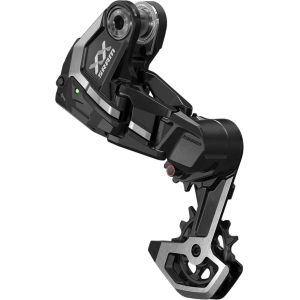
The architecture of the XX DH derailleur is similar to existing Transmission derailleurs, but the links are shorter to reduce its width, and the cage and pulleys are beefier. The battery mounts horizontally like a GX Transmission derailleur, and apparently, the interface between the contact pins and the battery has been modified to reduce pin contamination or failure. Inside the P-knuckle is the same Type 4 damper found in other Transmission derailleurs that offers a constant breakaway force throughout its travel. However, it feels much tighter due to the shorter cage's reduced leverage. When you combine the Full Mount, Type 4 damper, and the derailleur's compact size, it’s stupid quiet. Which if I’m being honest, is the main thing I want from my DH drivetrain. Make me forget I even have gears. There is also minimal chain whip or flail from the cage rebounding, adding to the tranquility.


Now I’m sure some of you couldn't care less about how solid and silent the derailleur functions because you wouldn’t dare add more unsprung weight to your bike. That’s fair. The delta between a mechanical X01 7-speed derailleur and XX DH Transmission derailleur is ~166 grams. The cassette difference is just 15g. It’s something, but not everything. SRAM said during testing that they couldn't derive a meaningful difference in suspension performance from the extra weight. Instead, most riders found their bike rode better due to the lack of noise and chain movement. I definitely fall into the latter group, so I’ll let everyone else argue this point from here on out.

The derailleur is paired and operated by an AXS POD controller. The same AXS App used across all SRAM electronic components can be used to configure buttons, make micro adjustments, and perform updates. The cassette, derailleur, and chainring also require a T-Type flat-top chain, just like a 12-speed Transmission.
XD Slim


The new DH cassette is offered in two versions. With 12x148mm Boost spacing becoming more common on DH bikes, SRAM has created a new, narrower XD SLIM driver body. This allows the driveside hub flange to move outward, creating a wider, symmetrical bracing angle that’s similar to 12x157 spacing.
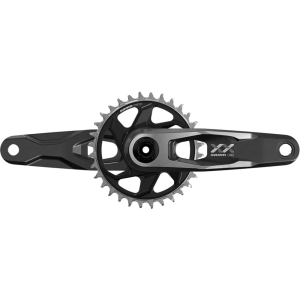
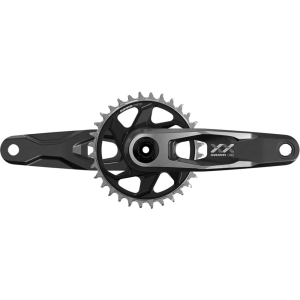
There are all-new aluminum cranks that share a similar look to SRAM's X0 cranks. They feature machined surfaces where your shoes typically rub, and on the end of the crank arm to help keep them looking pretty for longer. The length range now also includes 150, 155, 160, and 165mm. Before, it was just 165 and 170mm.

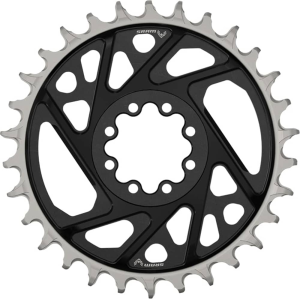
The cranks are joined by a new XX DH T-Type chainring that’s been designed to offer the most folding and impact resistance. It’s offered in a 6mm offset, direct-mount version for a 56.5mm chainline. There is also a new 104 BCD XX T-Type chainring to work with an Ochain. Both chainrings are available in a 32, 34, or 36T.
Installation follows the same Prepare, Hang, Tighten Process as 12-speed Transmission. You can plug in your bike online, and it’ll spit out the chain length and setup cog based on your chainring size and geometry configuration. If your bike isn’t included, or you’re running a chainguide or have an idler, SRAM has a slightly modified way of determining chain length and hanging angle. You can follow the instructions here.
XX DH Derailleur | XX DH Cassette | XX DH Cranks |

| 
| 
|
XX Eagle Chain | 104 BCD XX Chainring | POD Ultimate Controller |

| 
| 
|
On The Trail
I spent three days banging out laps with the new drivetrain hanging from a Commencal Supreme V5 in Queenstown, NZ. There are definitely worse ways to spend a Sunday to Monday. Three days, 28 runs. It wasn’t a summer in the bike park or a regional race series. But it was enough to elevate my standards for how quiet and reliable a DH drivetrain should be.

The MVP of the drivetrain was the derailleur. It was stiff, silent, and minimized chain flail, unlike any DH derailleur I’ve ridden. Not to take away from the shifting speed and consistency, it was perfect by all accounts, but I was shifting maybe four times per run as I casually pedaled into trails. Shifts were snug and crisp every time, but that’s expected when everything’s new. Lack of maintenance has been a highlight of 12-speed Transmission, and I expect the DH stuff to hold up similarly, if not better.
I have no proof that a quiet bike is a fast bike, but I’ll preach it as the truth till the day I die.
My attention was hyper-focused on how calm my bike rode because there was minimal drivetrain chaos. I have no proof that a quiet bike is a fast bike, but I’ll preach it as the truth till the day I die. Gone was that specific clunk-thud sound that comes from the parallelogram knocking through compressions. All that was left was some minor cage movement. Watching videos back, it's wild how little the whole mech moves, and how small the cage travels even during bottom-out events.
Unfortunately, I never smoked the derailleur on anything. As someone who rides left foot forward, it seems harder than ever to actually hit something. I did kick it, stand on it, and sprayed it with water every day for good measure. Like the shifting performance, time will tell how it holds up and if it remains quiet. So far, all signs point to a longer lifespan than I ever achieved with the previous mechanical derailleur.

The entire groupset is incredibly sharp and sleek-looking. It also costs a couple of months rent. The way I see it, there will be a group of riders who rush out and buy everything because they’ve been waiting decades for a wireless DH drivetrain. They will be joined by all the racers who get everything for free. Then there is the rest of us, intrigued but unable to fathom spending that much money on a DH drivetrain. We have to sit patiently, fingers crossed, that SRAM will do as SRAM does and release a cheaper groupset (or two) in the near future. If I’m being really greedy, I hope we see a 90 DH Transmission down the line as well. I’ve been blown away by Eagle 90 on my trail bike, and I think it would hit the sweet spot of budget and performance that many downhill riders would appreciate.
My excitement is less about the electronics and more about the durability and reliability SRAM has baked into each component.

What’s The Bottom Line?
SRAM’s DH Transmission is a step above any DH drivetrain I've ridden. The shifts are exact and immediate; the lack of a cable, housing, or adjustment screws simplifies setup and maintenance; and the derailleur's mounting interface and architecture make it crazy-quiet and resilient. I’m sure many riders won’t see the point in a wireless, electronic downhill drivetrain. Especially one as expensive as the initial XX groupset. But odds are high we will see more economic tiers in time. My excitement is less about the electronics and more about the durability and reliability SRAM has baked into each component, which sets DH Transmission up to withstand the thrashing of downhill riding better than any drivetrain that’s preceded it.
View key specs, compare, and review SRAM Transmission in the Vital MTB Product section.
| Where To Buy | |||
|---|---|---|---|

|
Free shipping on orders over $50 (continental U.S. only).
International shipping available. Some exclusions apply. |
Free shipping on orders over $50 (continental U.S. only).
International shipping available. Some exclusions apply. $700.00
|
|
|
|||
|
|||
|
|||
|
|||

|
Free shipping on orders over $49 (continental U.S. only).
International shipping available. Some exclusions apply. |
Free shipping on orders over $49 (continental U.S. only).
International shipping available. Some exclusions apply. $700.00
|
|

|
|||

|
|||

|
|||

|
Free standard UK delivery on orders over £50.
|
||

|
Free shipping on orders over $69 (continental U.S. only).
International shipping available. Some exclusions apply. |
||
2/24/2026 7:00am


View replies to: SRAM Finally Made a Wireless Electronic DH Drivetrain - XX DH Transmission Review
Comments